


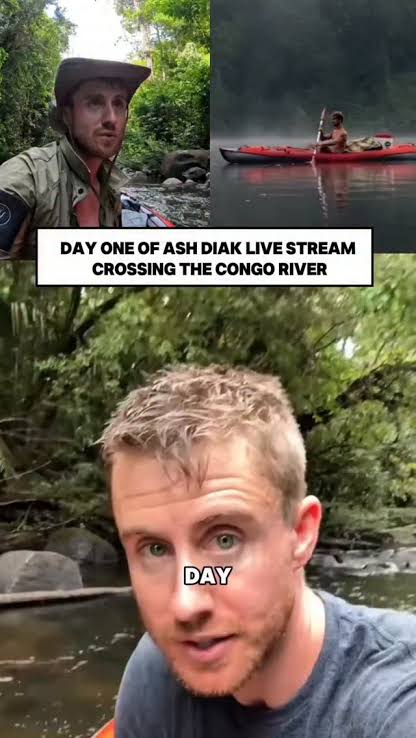
British adventurer Ash Dykes has embarked on another extraordinary expedition, taking on one of Africa’s most powerful and unforgiving waterways — the Congo River.
Already on the journey, Dykes is kayaking through the vast Congo River Basin, confronting an environment where immense stretches of water, powerful currents, remote wilderness and dangerous wildlife combine to create one of the most demanding adventures imaginable.
The Congo is enormous, and its depth can vary dramatically along its course. Some sections are relatively shallow, while others plunge to extraordinary depths. The Congo River reaches more than 220 metres (720 feet) deep in places, making it one of the deepest rivers ever recorded. For a kayaker, such depths are a reminder of how little control humans have once they are surrounded by the river’s immense volume of water.
But depth is only one part of the danger.
The river is characterised in places by powerful currents, rapids, whirlpools and turbulent sections that can make navigation extremely difficult. In remote areas, a capsize or serious injury could become a life-threatening situation because medical assistance and rescue facilities may be extremely far away.
And beneath the surface lies another source of uncertainty.
The Congo River and its surrounding waterways are home to large and potentially dangerous animals, including hippos, crocodiles and giant catfish. Hippopotamuses are particularly dangerous when threatened or when their territory is approached. They can move surprisingly quickly in water and are capable of attacking boats and people.
Crocodiles also inhabit parts of the Congo Basin, presenting another potential hazard to anyone travelling close to the water. Beneath the surface are also numerous species of fish, including the famous Goliath tigerfish, a large predatory fish with formidable teeth that has become one of the Congo’s most iconic aquatic predators.
The wildlife threat extends beyond the river. Dykes is travelling through one of the world’s great tropical wildernesses, where dense rainforest can harbour snakes, insects and other animals capable of posing dangers to an expedition team.
Yet perhaps the greatest challenge is the environment itself.
The Congo Basin is vast, remote and difficult to navigate. Heavy rainfall, extreme humidity, dense vegetation, powerful waterways and long distances from civilisation can turn a small problem into a major survival challenge.
For Dykes, however, confronting such uncertainty is at the heart of exploration. His kayak places him directly on the river, where every rapid, current and bend presents a new challenge.
This is not simply a sightseeing trip down an African river. It is an expedition into a wilderness where the water can be hundreds of metres deep, currents can become treacherous and encounters with powerful wildlife are possible.
As Ash Dykes continues his journey, each paddle stroke takes him deeper into one of the planet’s most extraordinary natural environments a place of breathtaking beauty, immense power and genuine danger.
The Congo is magnificent. It is also unforgiving. And Ash Dykes is now confronting it from the seat of a kayak.